Request headers
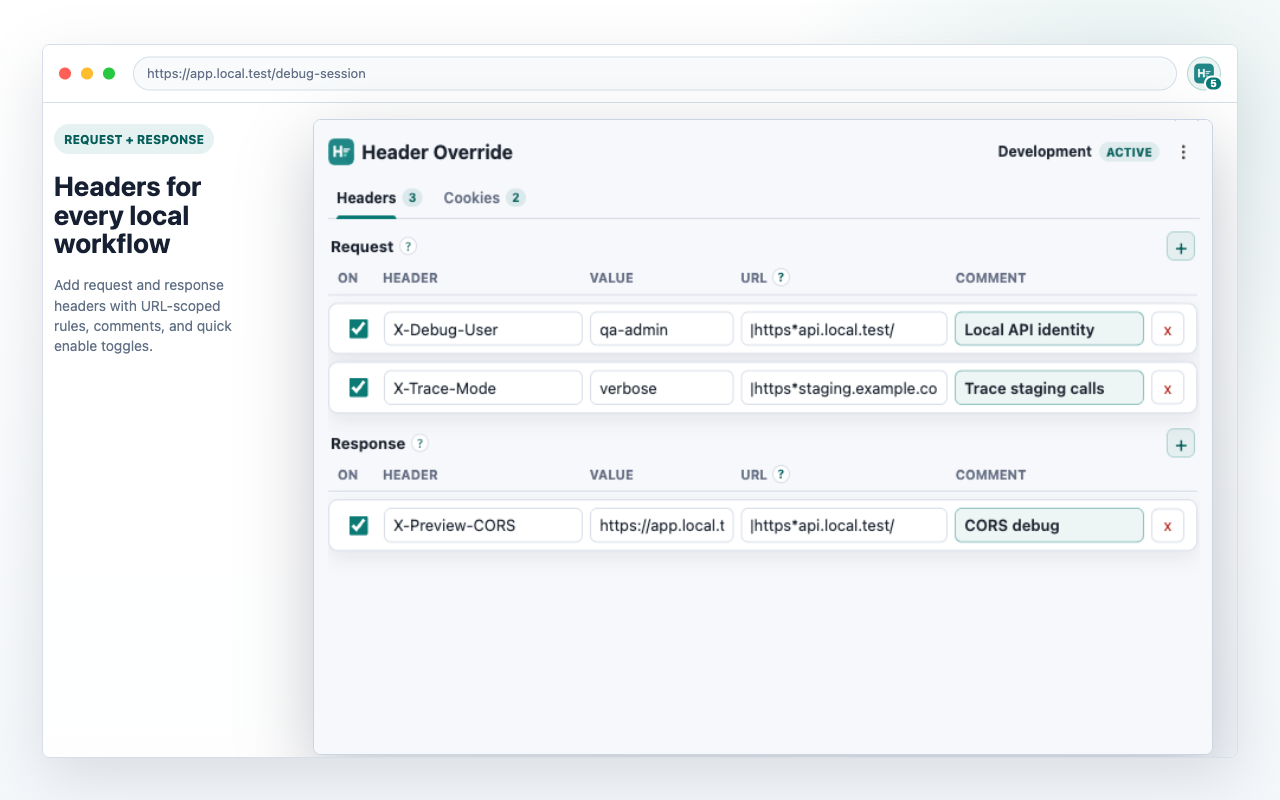
Add or replace outgoing HTTP request headers for matching URL patterns.
ModHeader alternative
Header Override is an open-source, lightweight browser extension for developers, QA engineers, and support teams who need a focused alternative to ModHeader for scoped request headers, response headers, and cookies.
Why switch
Header Override keeps the workflow small: create a rule, choose the request or response behavior, scope it to matching URLs, and keep profiles for the setups you reuse. Rules are saved locally in your browser and are not sent to the developer. The project source is public on GitHub so the extension can be reviewed directly.
Add or replace outgoing HTTP request headers for matching URL patterns.
Apply response header changes from the same focused browser extension popup.
Override request cookies and response Set-Cookie values, including common response cookie attributes.
Keep separate local setups for projects, clients, environments, and test accounts.
Rules stay in browser extension storage and are not sent to a developer server.
No analytics, advertising, tracking, remote code, or external service dependency.
The extension source is public on GitHub for review, issue reports, and contributions.
Search intent
If you need to modify HTTP headers in Chrome, Edge, or Firefox, Header Override gives you request header, response header, request cookie, and response cookie rules in one local extension.
It keeps ModHeader alternative comparisons focused on a smaller local workflow.
Yes. Header Override is a browser extension for users who need to modify HTTP headers and cookies with scoped local rules. It focuses on a small, privacy-first workflow rather than a broad debugging platform.
Yes. Header Override supports request header rules and response header rules, and each rule can be scoped to browser-supported URL filter patterns.
No. Header Override stores rules locally in browser extension storage and does not transmit rule data or browsing activity to the developer or developer-controlled servers.